
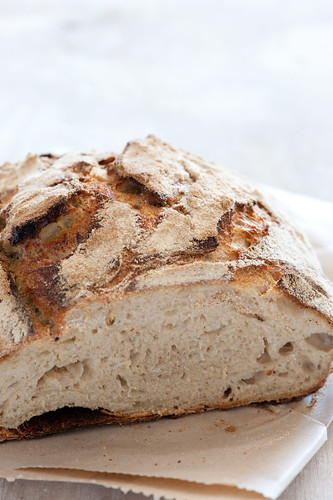
Rustic Homemade Sourdough
From Stonesoup
makes 1 loaf
In the early days of your starter you can use it for the extra flavour but you’ll need to use 1/4 teaspoon dried yeast to work it’s magic. But once your starter is active and bubbling away, you can ditch the yeast. Just make sure you don’t put any of the commercial yeasted dough near your starter or these stronger strains will takeover. Good idea to always use a clean spoon when making your starter.
I prefer to use unbleached, stone ground organic bread flour and filtered water, but I’ve also used supermarket flour with great results.
325g (11oz) bread flour
200g (8oz) sourdough starter
275g (10oz) water
1 teaspoon find grained salt
semolina, optional
1. In a large bowl combine flour, starter, water and salt until just mixed together.
2. Cover with cling wrap and leave overnight for at least 8 but preferably 12 hours.
3. Form your loaf. Place a generous amount of flour on your kitchen counter. Scoop dough out onto the flour then sprinkle generously with more flour. Gently fold the edges from the outside in to form a round loaf.
4. Place more flour on a clean tea towel. Place loaf with the rough top side down. Sprinkle with semolina, if using, or more flour. Cover.
5. Place a large oven proof dish with a lid in the oven. Preheat oven and the pan to the highest setting for at least 1/2 hour.
6. Carefully remove the hot pan from the oven. Remove lid. Sprinkle a little semolina, if using in the base of the pan. Gently place loaf in the pan inverted so that the rougher surface is now on top. Don’t worry about smoothing it out or having it centered – it will work itself out in the oven.
7. Pop the lid back on and bake for 30 minutes.
8. Remove the lid and turn the oven down to 200C (400F) bake for a further 15 minutes until the loaf is deep brown.
9. Cool on a wire rack uncovered for at least 30mintues if you can wait that long.
Prepare Ahead?
You can par bake the loaf and freeze. Just bake loaf for 30 minutes with the lid on then cool the loaf on a rack and freeze. To reheat, preheat the oven to 200C (400F) and bake straight from the freezer on a baking tray for 20 minutes or until the loaf is deep golden brown.
Variations
olive bread – deseed a large handful of your favourite olives and work into the dough when forming your loaf. Lovely with a little thyme as well.
walnut loaf – work a couple of handfuls of walnuts into the bread when you’re forming your loaf.
raisin loaf – soak 2 generous handfuls of raisins in 1/4 cup hot water for about half an hour. Drain and work into the bread when you’re forming your loaf.
Problem Solving Guide
too wet – if the crumb is soggy after the loaf has cooled it means it is under baked. This is a common problem if you’re just using a regular saucepan to bake your loaf. A heavier cast iron pot will radiate more heat into your loaf. If you can’t justify buying a new pot, make sure you bake the loaf for longer with the lid on. It may take an extra 15 minutes. Keep experimenting with your oven until you are happy
dough really runny – with this bread the dough is meant to be super runny. The wet nature of the dough is the secret to getting a lovely light loaf. Be brave and bake it anyway.
burned – Remember to turn the oven down when you take the lid off. Or bake for less time with the lid off.
loaf too flat – 5 possible causes here:
1. Inactive or sluggish starter – make sure starter is active and you’re letting the dough rise in a warm place. You can add a little dried yeast to help things along.
2. Gluten not developed – next time allow to rise for longer OR make sure you’re letting the dough rise in a warm place.
3. Dough not wet enough – next time try to use less flour when forming your loaf.
4. Oven not hot enough – make sure you preheat your pot for at least 1/2 hour on the highest setting.
5. Flour protein content too low – try a different brand of flour and make sure it is designed to be used for bread making.
crust too soggy – another symptom of underbaking. Next time bake longer at the first stage. Also make sure the loaf isn’t covered when its cooling as the steam can make your crust soggy.
can’t find semolina? – semolina is just coarsely ground wheat that looks a little like sand. It makes a lovely rustic crust on the bottom of your bread but it isn’t essential. Fine polenta or cornmeal makes a good substitute or just use a little flour to dust the base of the pot.
Serving Suggestions
Wonderful warm from the oven with a generous layer of butter or dipped into a peppery olive oil.
Makes beautiful sandwiches. Or serve as an accompaniment to your favourite soup or stew.
Leftover Potential
Because there aren’t any additives it wont stay fresh as long as commercial bread. I just slice any leftovers and freeze until needed.
related links
nil.
_______________________
back to Simple Breadmaking Overview Page


 Add to my Old Favourite Recipes
Leave a Reply